Superlabby is an adaptive progression framework that balances profitability with resilience by restructuring recovery instead of escalating risk unlike traditional progressions.
EVOLUTION OF SUPERLABBY
SUPERLABBY
Adaptive Progression with Autonomous Vault Recovery
A Practical Demonstration of Resilience Under Extreme Adversity
A DIFFERENT PHILOSOPHY
Most progression systems are built around a single assumption—that favourable results will arrive before the progression becomes unmanageable.
When that assumption fails, the progression itself usually becomes the problem.
Martingale requires exponentially increasing stakes. Fibonacci continually advances into larger numbers. The traditional Labouchere line can grow into a lengthy sequence requiring increasingly difficult recovery.
Superlabby approaches the problem differently.
Rather than attempting to recover losses through ever-increasing stakes, it focuses on survival first and recovery second.
The architecture combines:
- Adaptive Labouchere sequence management
- Intelligent sequence regeneration
- Automatic structural adjustment through zero and one injection
- Maximum bet limitation
- Autonomous Vault Recovery
- Hard stop-loss architecture
- Complete LW Array recording
- Detailed session analytics
- One-click CSV export and replay
When the predefined drawdown limit is reached, the system does not continue escalating.
Instead, the accumulated deficit is reclassified as Vault Debt, allowing recovery to proceed in structured blocks while maintaining controlled stake sizes.
The objective is not to predict future outcomes.
The objective is to remain operational through adverse sequences while maintaining a recovery structure that avoids uncontrolled progression growth.
A SESSION DESIGNED TO TEST RESILIENCE
The accompanying documented session represents one of the most difficult sequences tested.
Session Statistics
Metric Result
Total Bets 463
Wins 208
Losses 255
Win Rate 44.9%
Worst Balance -51 Units
Final Balance +51 Units
Maximum Bet 7 Units
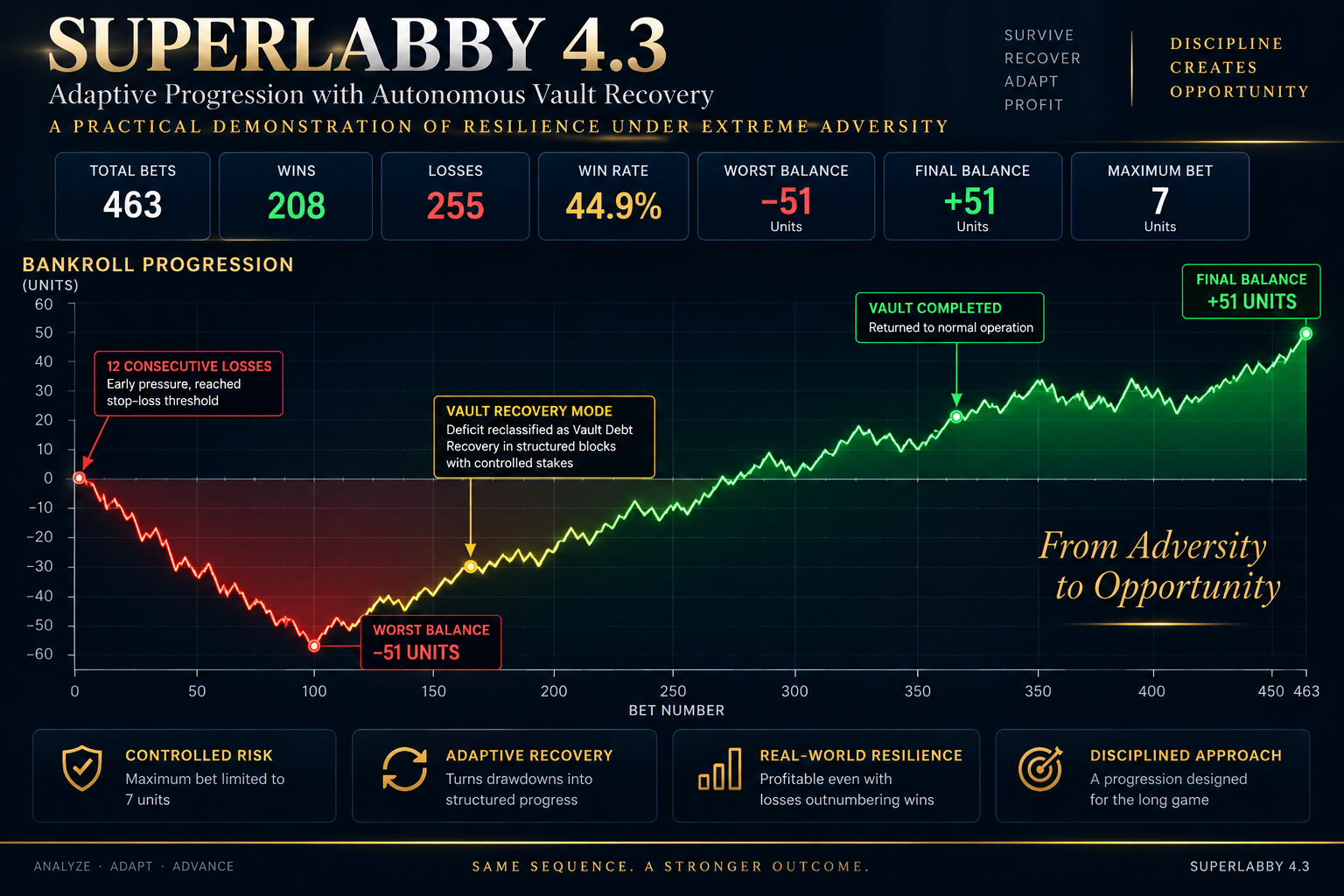
The session began with twelve consecutive losses and faced too many false recoveries, no corrective or clumping win clusters eventually reaching the programmed stop-loss threshold before entering Vault Recovery Mode.
Despite operating under a win rate below 45%, the session ultimately recovered the vault and finished at its highest recorded balance.
THE LW ARRAY
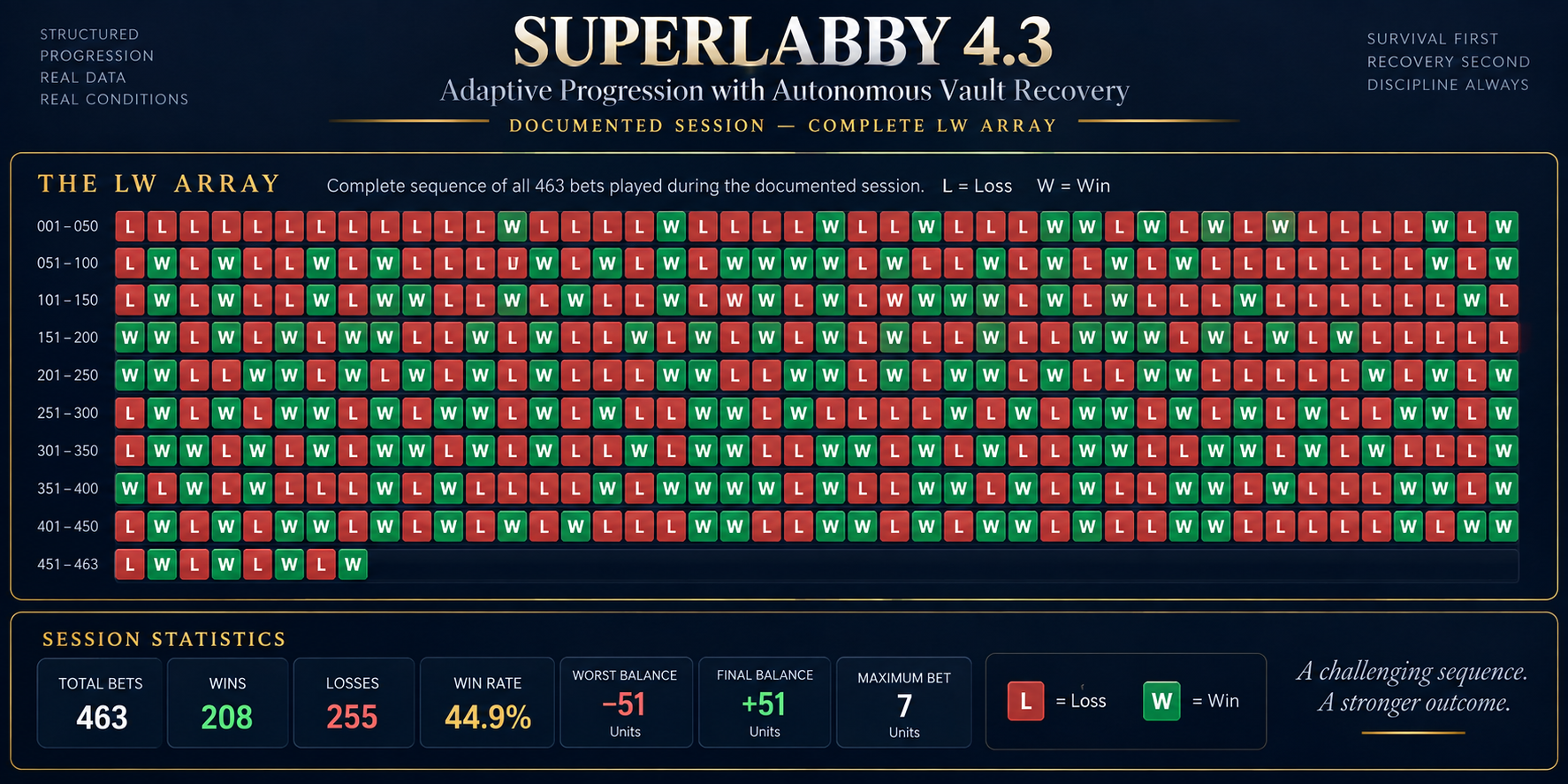
The following LW Array represents the complete sequence of all 463 bets played during the documented session.
Session sequence
Grouped as 20 decisions per line in sets of 5 for readability.
LLLLLLLLLLLLWLLLLWLLLLLWLLWLLLWWLWLWLWLLLLLWLWLWLLLLWWLWLWLWLLWLWLLLLWLWLWLWWWWLWLLWLWLWLWLLLLLWLWLWLWWLWLWLWLWLLWWLWLWLWWLLWLWLLWLLWLWLLWWWLWLWLLWLLLLLWLWWLWLWLWLWWWLWLWLLLLLWLWLWLWWLLWWLWLWLWLWLLWLLWWWLWLWLWLLLLWWLLWWLWWLWLWLWLWWLWLWLWLWLWLLLWWLLWWLWLWWLWLLWWLLLLWLWLWLWLWWLWLWLLLWLWLWWLWLWWLWLWLLWWLWLLLLWLWLWWLWLWLWLWLLWLLLWLLLLWLWWLWWLWLWLWWLWLWLLWLWWLLWWLWLWLLWWLLWLWLLWLWWLLWWLWLWLWLLWWLWLWLLLWLWLLLLWLWWWWLWLLWWLWLWLLWLWLWLLWWLWLLWWLWLWLLLWWLWWLWLWLWWLWLW
This sequence illustrates why the session is noteworthy.
It is not characterised by long winning streaks.
Instead, it contains:
- Twelve consecutive losses at the very beginning
- Numerous irregular losing clusters
- Frequent interruptions of recovery
- A prolonged period below break-even
- Only a 44.9% overall win rate, meaning losses actually outnumbered wins by 47 bets
This type of sequence places sustained pressure on progression systems because recovery opportunities are repeatedly interrupted before momentum can build.
Rather than experiencing a smooth recovery, the tracker was forced to repeatedly adapt while maintaining relatively modest bet sizes.
The documented session therefore serves as an example of how the Superlabby 4.3 architecture behaves under unusually adverse conditions rather than under favourable circumstances.
HOW WOULD CLASSICAL PROGRESSIONS RESPOND?
Martingale
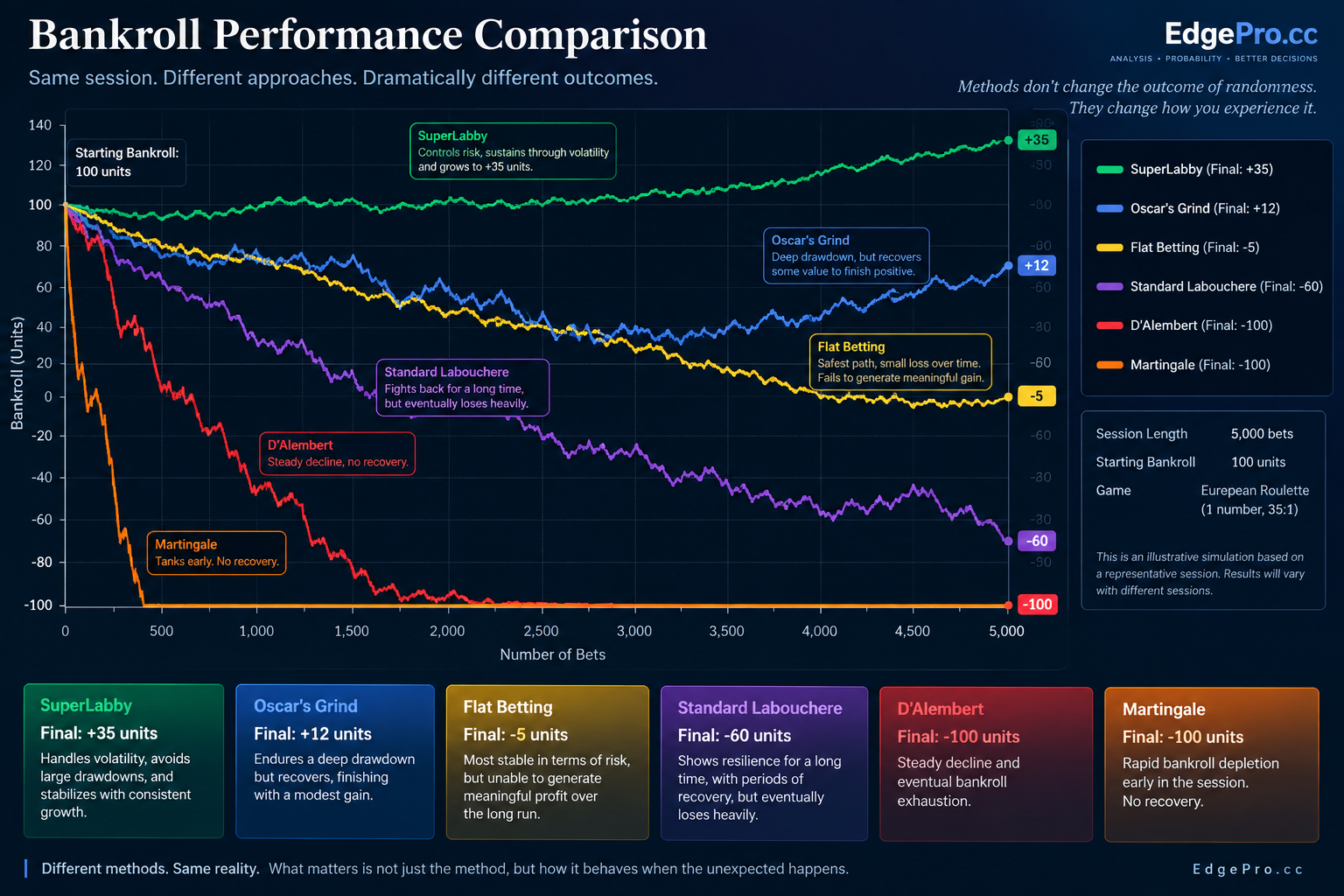
Martingale doubles the stake after every loss. A sequence beginning with twelve consecutive losses causes stake sizes to increase exponentially, quickly exceeding the bankroll or table limits encountered in most practical environments. Long before the session reaches its midpoint, many players would likely be unable to continue. Given Bankroll of 100 units and max bet of 20 units, it busted to no recovery, not once but several times, in this session. Long stretches of losses killed it.
Classical 1-2 Labouchere
Traditional Labouchere continually extends its working line during prolonged losing periods. A hostile sequence such as the documented LW Array would be expected to produce a significantly longer cancellation line, increasing both future stake sizes and the complexity of recovery. Given Bankroll of 100 units and max bet of 20 units, it busted to no recovery, not once but several times, in this session.
Fibonacci
Fibonacci progresses more slowly than Martingale but still requires steadily increasing wagers during extended losing streaks. Multiple losing clusters throughout this session would drive the progression deeper into the sequence before meaningful recovery could occur. Even worse than 1-2 labby, Given Bankroll of 100 units and max bet of 20 units, it busted to no recovery, not once but several times, in this session.
D'Alembert
D'Alembert increases stakes gradually, limiting escalation but also slowing recovery. After a drawdown exceeding fifty units, a substantial number of favourable outcomes would generally be required simply to return to break-even.
Oscar's Grind
Oscar's Grind performs best when winning sessions develop steadily. In a sequence dominated by repeated interruptions from losing clusters, progress toward recovery is typically much slower because stake increases occur only after successful outcomes. This method looked for favorable win clusters and not finding enough in the session, lost huge to become irrecoverable.
HOW SUPERLABBY RESPONDED
Rather than attempting to recover the entire drawdown immediately, Superlabby 4.3 automatically converted the accumulated deficit into Vault Debt once the predefined stop-loss threshold was reached.
Recovery then proceeded in structured blocks while continuing to manage stake growth. Once the vault had been completely retired, the tracker automatically returned to normal operation and ultimately completed the documented session with:
- Final Profit: +51 Units
- Maximum Bet: 7 Units
- Complete Vault Recovery
- Controlled Progression Throughout the Session
CONCLUSION
Superlabby 4.3 is not designed to eliminate uncertainty or predict outcomes.
Its objective is to provide a progression architecture that remains structured during difficult periods by combining adaptive sequence management with controlled recovery.
The documented session demonstrates one example of that behaviour under an unusually hostile LW pattern, where losses exceeded wins and the session experienced a significant early drawdown before eventually recovering.
DISCLAIMER
The results presented in this document relate solely to the analysed session. No betting progression can guarantee profits or ensure that every session will end positively. Exceptionally rare or highly adverse win/loss patterns may still overcome the recovery architecture. Users should regard Superlabby 4.3 as a structured progression framework rather than a guarantee of future performance and should always practise responsible bankroll management.